How to Start Investing in Stocks in India — Beginner's Guide
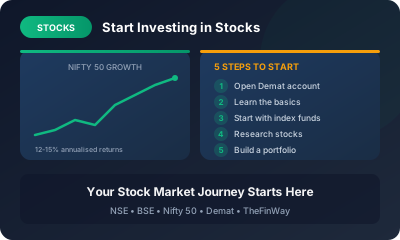
The Indian stock market has delivered 12-15% annualised returns over the long term, outperforming every other asset class. Yet most Indians still avoid stocks out of fear. If you've been wanting to start but don't know how, this guide walks you through everything step by step.
Step 1: Open a Demat + Trading Account
You need two accounts to invest in stocks:
- Demat account — holds your shares electronically (like a bank account for stocks)
- Trading account — used to place buy/sell orders on the stock exchange
Most brokers open both together. Popular options: Zerodha, Groww, Angel One, Upstox, ICICI Direct. The process is fully online — Aadhaar, PAN card, bank account and a selfie. Takes 1-2 days.
Step 2: Understand the Basics
- NSE & BSE — India's two stock exchanges. Most stocks are listed on both
- Nifty 50 — Index of India's top 50 companies (TCS, Reliance, HDFC, Infosys, etc.)
- Sensex — Index of top 30 companies on BSE
- Market cap — Large-cap (₹20,000+ Cr), mid-cap (₹5,000-20,000 Cr), small-cap (under ₹5,000 Cr)
- P/E ratio — Price-to-Earnings ratio. Lower P/E = relatively cheaper stock
Step 3: Start with Index Funds or ETFs
If you're a complete beginner, don't pick individual stocks yet. Start with:
- Nifty 50 Index Fund — automatically invests in India's top 50 companies
- Nifty Next 50 — the next tier of large companies with higher growth potential
- Nifty 50 ETF — trades like a stock, tracks the Nifty index at very low cost
This gives you diversified equity exposure without the risk of picking the wrong stock.
Step 4: Learn to Pick Individual Stocks
Once comfortable, research companies using these filters:
- Revenue growth: Is the company growing sales consistently (10%+ annually)?
- Profit margins: Is it actually making money after all expenses?
- Debt-to-equity ratio: Below 1 is generally healthy
- Return on equity (ROE): Above 15% indicates efficient capital use
- Promoter holding: Higher promoter stake (50%+) generally signals confidence
Step 5: Build a Portfolio
| Allocation | What | Why |
|---|---|---|
| 60% | Large-cap / Index funds | Stable, lower risk |
| 25% | Mid-cap stocks/funds | Growth potential |
| 15% | Small-cap stocks/funds | High growth, high risk |
Start with 5-10 stocks maximum. Diversify across sectors — don't put everything in IT or banking.
Golden Rules for Beginners
- Invest only what you can leave for 5+ years — stocks are volatile short-term
- Never invest borrowed money — no margin trading or loans for stocks
- Don't chase tips — WhatsApp groups and Telegram channels are mostly scams
- Invest regularly (SIP) — ₹5,000/month via SIP beats trying to time the market
- A 20% drop is normal — the market crashes periodically. Don't panic sell
Taxation on Stock Gains
- STCG (held < 1 year): 20% tax on gains
- LTCG (held > 1 year): 12.5% tax on gains above ₹1.25 lakh/year
- Dividends: Taxed at your income tax slab rate
Track Your Stock Portfolio
Keep all your investments visible in one place. Use TheFinWay's portfolio tracker to monitor your stock and mutual fund holdings alongside other assets and see your complete financial picture.
Start Your Financial Journey
TheFinWay helps you track net worth, budget expenses, plan retirement and achieve financial independence — all for free.
Try TheFinWay Free →