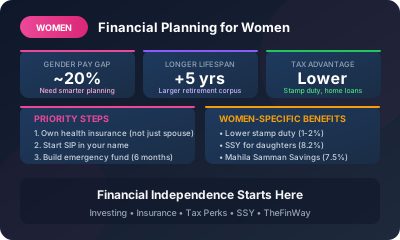
Financial Planning for Women in India — A Practical Guide
Financial independence isn't optional — it's essential. Whether you're a working professional, a homemaker, or running a business, taking charge of your finances ensures you're never dependent on anyone else for your financial security.
Why Financial Planning Is Especially Important for Women
- Longer life expectancy — women in India live on average 2-3 years longer than men, meaning retirement corpus needs to last longer
- Career breaks — maternity leaves, caregiving responsibilities, or relocation for a spouse's job can create gaps in income and retirement savings
- Gender pay gap — women in India earn approximately 19% less than men for similar roles, making intentional savings even more important
- Single by circumstance — divorce, separation, or loss of a spouse can create sudden financial responsibilities
Step 1: Build Your Own Financial Identity
- Have a bank account in your own name with sole control
- Get a PAN card and complete KYC for investments
- Start building a credit history — get a credit card, use it responsibly
- Know all family finances — joint assets, loans, insurance policies, investments
Step 2: Emergency Fund First
Before any investing, build 6 months of expenses in an accessible savings account or liquid fund. This is non-negotiable. An emergency fund protects you from having to sell investments during a crisis or, worse, borrow at high interest.
Step 3: Get Your Insurance Right
- Health insurance — a personal policy in your own name, not just dependency on your spouse's employer coverage. ₹5-10 lakh individual policy at age 30 costs approximately ₹5,000-12,000/year
- Term insurance — if anyone depends on your income (children, parents, spouse), term insurance provides financial protection
Step 4: Start Investing Systematically
You don't need large amounts to begin. Many successful investors started with ₹500-1,000 monthly SIPs:
- PPF — guaranteed returns, tax-free, 15-year lock-in. Great for long-term safe savings
- ELSS mutual funds — equity exposure with tax benefits (80C), 3-year lock-in
- Index funds — low-cost, simple, diversified market exposure via SIP
- Sukanya Samriddhi Yojana — if you have a daughter under 10, this offers attractive interest rates with tax benefits
Step 5: Plan for Retirement
This is where career breaks hurt the most. Every year not contributing to EPF or NPS is a year of lost compound growth. If you take a 5-year career break at age 30:
- At 12% returns, ₹10,000/month invested from age 25-30 would grow to ~₹8.2 lakh
- That ₹8.2 lakh untouched until age 60 would grow to ~₹2.4 crore
- Missing those 5 years of contributions (₹6 lakh total) costs approximately ₹1.7 crore at retirement
If you take a break, try to continue investing even ₹2,000-5,000/month to keep compounding alive.
Step 6: Understand Tax Benefits
Women have the same tax benefits as men, plus:
- Lower stamp duty on property registration in many states (1-2% less)
- Sukanya Samriddhi Yojana for daughters — up to ₹1.5 lakh/year with Section 80C benefit
- Section 80C, 80D, NPS (80CCD) deductions apply equally
Step 7: Have the Money Conversation
Whether married or single, know your complete financial picture:
- Total household income and expenses
- All investment accounts and their nominees
- Insurance policies and their coverage
- Outstanding loans and their terms
- Wills and succession planning
Take Control Today
Start by knowing where you stand. TheFinWay helps you track your net worth, manage expenses, set financial goals, and plan retirement — all in one free app. Your financial independence journey begins with visibility.
Start Your Financial Journey
TheFinWay helps you track net worth, budget expenses, plan retirement and achieve financial independence — all for free.
Try TheFinWay Free →